

Keep in touch, p.1
Keep in Touch, page 1


Copyright © Nancy Silcox, 2025
All rights reserved. No part of this publication may be reproduced, stored in a retrieval system, or transmitted in any form or by any means, electronic, mechanical, photocopying, recording, or otherwise (except for brief passages for purpose of review) without the prior permission of Dundurn Press. Permission to photocopy should be requested from Access Copyright.
Publisher and acquiring editor: Meghan Macdonald | Editor: Tim Hilts
Cover designer: Laura Boyle
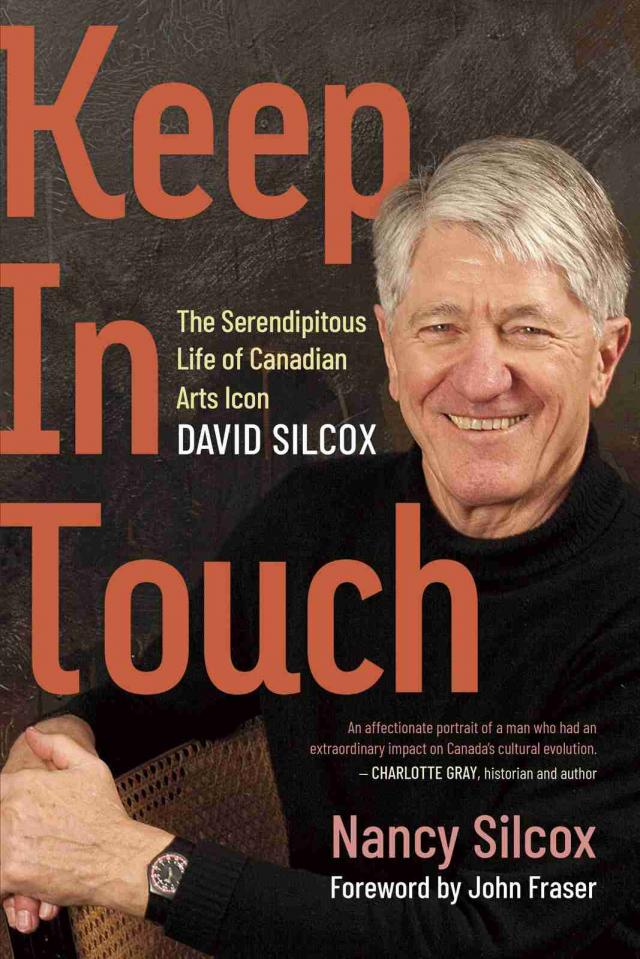
Cover image: Nancy Rahija
Library and Archives Canada Cataloguing in Publication
Title: Keep in touch : the serendipitous life of Canadian arts icon David Silcox / Nancy Silcox ; foreword by John Fraser.
Names: Silcox, Nancy, 1949- author
Description: Includes bibliographical references and index.
Identifiers: Canadiana (print) 20250221764 | Canadiana (ebook) 20250221802 | ISBN 9781459756410 (softcover) | ISBN 9781459756434 (EPUB) | ISBN 9781459756427 (PDF)
Subjects: LCSH: Silcox, David P. | LCSH: Art patrons—Canada—Biography. | LCSH: Arts, Canadian—20th century. | LCGFT: Biographies.
Classification: LCC NX513 .S55 2025 | DDC 700.971—dc23
We acknowledge the support of the Canada Council for the Arts and the Ontario Arts Council for our publishing program. We also acknowledge the financial support of the Government of Ontario, through the Ontario Book Publishing Tax Credit and Ontario Creates, and the Government of Canada.
Care has been taken to trace the ownership of copyright material used in this book. The author and the publisher welcome any information enabling them to rectify any references or credits in subsequent editions.
The publisher is not responsible for websites or their content unless they are owned by the publisher.
Printed and bound in Canada.
Dundurn Press
1382 Queen Street East
Toronto, Ontario, Canada M4L 1C9
dundurn.com, @dundurnpress
To strong family ties
Foreword
The thing about David Silcox I remember most is his smile. The thing everyone remembers most is his smile. It never seemed forced and was invariably tied to a moment: an unexpected meeting in a corridor, arrival at a committee hearing, the discovery of a mutual acquaintance, the end of a good conversation or a conversation-fuelled meal together, even the looming spectacle of a seemingly insurmountable problem that invariably turned out to be … well, surmountable. Especially if it was accompanied by that smile.
The other thing I remember is loyalty — loyalty to friends, loyalty to institutions he loved, loyalty to a cause. He was so damn loyal he could manage to give his trademark loyalty to people, causes, and institutions that, on the surface, were not natural partners with each other (except in his fertile mind) and make them all feel well served.
He was, for just one example, incredibly loyal in his admiration and friendship with Toronto artist and occasional troublemaker Harold Town. Town, while he was still alive, had obtained David’s pledge to help look after his artistic estate after his death. Here is a great example of David Silcox solving both ends of an equation to the benefit of all. It’s a good story.
Recognizing that in the years immediately following Town’s death, the artist’s output would face the usual decline in popularity in the art world, David conspired to keep up interest in Town while his works, in David’s care as Town’s executor, were carefully stored away. One crucial thing he did was to selectively loan, or donate, pieces of Town’s work to institutions that would properly display them to advantage. This was how Massey College, where David maintained his “headquarters” following his years of government service, both federally and provincially (in Ontario), became a partner in the posthumous rehabilitation of a great Canadian artist. Eight wonderful oils, mostly painted in the years Massey College was conceived and erected (the early 1960s), ended up on the walls of its warm and inviting Upper Library, perfectly embellishing Ron Thom’s extraordinary architectural masterpiece.
In time, of course, Town caught on again, partly thanks to David’s careful placement of Town canvasses in places of influence. Those paintings became part of Massey College’s small but impressive (and valuable) art collection, and Harold Town’s reputation was fully restored. Town canvasses now fetch appropriate prices in the art-sale world or in auction houses. Ditto for other Canadian artists, from Christopher Pratt to Iain Baxter. David championed their work, and often it didn’t take more than a smile to get a skeptic on side. This was thanks to David’s other great gift: an infectious enthusiasm and optimism that was very hard to resist.
I wasn’t a canoeing enthusiast, at least not on the Silcox scale, and camping was my idea of hell on earth (literally on earth), so I am unable to testify to that truly important side of the Silcox experience, but he never held this against me. He knew very well how to judge the worth of friends (and foes), and this is why it often seemed as if he simply sailed through life. It wasn’t, of course, always smooth sailing, as this warm and useful sister-in-law-ly account of his life shows. But he was always able to fight amiably for the things that were important to him, and this was why even people who disagreed with him on this or that nevertheless always wanted to stay close to him. His was a life lived at full throttle. The only thing that could slow him down was age and its attendant vicissitudes, but even here the smile never left his handsome, welcoming face.
David Silcox’s story is an important one because it says a lot about what Canada means in the world of art, in the world of nature, in the world of governance. Important simply because his bright and beautiful and adroitly scheming mind was always in positive mode, never negative, so that institutions and artists he championed always shone. As a result, he added to the true measure of the Canadian soul. This is one of the reasons he is so sorely missed and why we can all be so grateful he passed by our way.
John Fraser, Master Emeritus
Massey College, University of Toronto
Preface
I first met David Silcox in late December 1968. The occasion was a wedding — my own — to Louis, his much younger brother. And I was charmed. The oldest of the four brothers, Dave was roguishly handsome, with a bountiful mop of chestnut hair and eyes that smiled. Flirtatious, too. He welcomed me to the family with a kiss. David’s gift to us was unique among the cookware, crystal vases, kitchen bowls, and bath towels: a curious painting of a menacing angelfish. We loved it, and the work had pride of place in our first student apartment.
And then he was gone. Back to Ottawa, where he answered to the title “Senior Arts Officer of the Canada Council” and travelled back and forth across Canada granting money to worthy up-and-coming artists. So very impressive.
Over the coming years, our paths seldom crossed, but reports of dapper Dave’s comings and goings were passed around, like bits of celebrity gossip, during family picnics and birthdays. “David told me that while he was studying at the Courtauld Institute in London, England, he’d had lunch with that guy, Sir Anthony Blunt. You know … the one who was a spy.” Or “Remember when Dave — he was a Queen’s Scout, you know — represented Canada at the Queen’s Jubilee?” And “David knows Margaret Atwood, our great Canadian writer — you knew that, didn’t you? The two of them published a literary magazine while they were at the University of Toronto together …” To a cosseted country girl like me, who had limited brushes with the world of the famous, the stories brought only a wish for more. And still more.
Over the ensuing years, as Louis and I settled into a life of school-teaching, child-raising, and house-building in rural Waterloo, Ontario, famous-brother reports grew in their frequency — and reverence. “They’re calling him ‘culture czar of Metro Toronto,’ you know” and “Pierre Trudeau was with him on his last canoe trip, I hear …”
Private chatter became public fame with David’s art-book bestsellers: Tom Thomson: The Silence and the Storm; The Group of Seven and Tom Thomson; Painting Place: The Life and Work of David B. Milne; and Christopher Pratt. Then a swanky new job on Parliament Hill and an impressive title: Assistant Deputy Minister of Culture. Then, up the power ladder to Queen’s Park. Not much time, these days, for the annual Silcox family reunion in the village of Frome, Ontario.
Then, a fall. Fired from his job as Deputy Minister of Culture for Ontario after Bob Rae’s New Democratic Party took office in 1990. Accused by a reporter of spending the taxpayer’s money on travel, theatre, and restaurants.
Gracefully, David Silcox, now an art broker, rose again, holding a prestigious job at Sotheby’s Canada. As President, no less. Selling six-figure art was his game and it fit him like a silk glove. Tales of finding long-lost Canadian art masterpieces in British back closets and Group of Seven treasures in the Vermont woods dominated the headlines, with David the master broker.
Dementia — a family predisposition — and Covid-19 changed all that. Now in his mid-eighties, David’s memory was fading — and such fine memories they were. Now confusion replaced clarity. Family, friends, and associates gave thanks that the brilliant prose of his art books endured.
As David’s dementia continued its assault, I, a biographer by profession, pondered and asked, “Did he keep a diary? Did he make notes?” The lamented answer was no. “Just a few scribblings, late in life …”
“Then I’ll do it. I’ll write his life story … because it must be told.”
* * *
Over the course of the ensuing two years, Keep in Touch: The Serendip itous Life of Canadian Arts Icon David Silcox was born and grew. And while the ravages of David’s advancing illness precluded me from exploring his own memories — ones that travelled back to Depression-era Saskatchewan — there were fine alternatives. Information on the Silcox family developed thanks to historical publications and an ardent family preoccupation with genealogy. David’s father, an inveterate scribbler, gave intimate details of family life during the Prairie Dust Bowl and the war. As David’s star rose through his early twenties and beyond, his comings and goings were noted in recordings, press interviews, and clips. David’s own scant and hastily written recollections on notepaper brought some insight into my subject’s personality and his reaction to events. But so much more was needed.
Over seventy individuals, including statesmen and politicians, writers and poets, artists and academics, and friends and family, eagerly added brilliant colour to this portrait. And so the story burst into living form. David’s death, on February 27, 2024, one month past his eighty-seventh birthday, saw my narrative still developing. By summer and early fall of that year, the story reached its end.
Yet many questions remained unanswered — mysteries still unsolved. In his biographer’s consciousness, one paramount question remained unanswered. How did this man of common background, a son, grandson, and great-grandson of clerks, farmers, educators, and churchmen, become a revered Canadian cultural giant? Deeper than that, what were the forces that had driven him, had shaped his life — his desires and goals, his victories and disappointments? Were they a product of old-world blood and heritage? New-world opportunity and ambition? Or luck and chance? A serendipitous concoction of all combined?
I invite readers of Keep in Touch: The Serendipitous Life of Canadian Arts Icon David Silcox to ponder this as well. His story begins with early Silcox family lore: of preachers and the famous “Grit and Grip” sermons.
In life, I barely knew you, Dave; only in decline and death did I get the glorious chance.
Nancy Silcox
New Hamburg, Ontario
May 2025
Part One Of Blood
(1831–1937)
Chapter One A Family Problem
As a striving adult, David Silcox rarely referred to his paternal grandfather, Albert Brotherhood Silcox. References to Grandpa emerged only when David revealed that his father, christened Albert Phillips Silcox, had, as a young man, demurred from being addressed as his namesake. “Father’s strong feelings against his father made him refuse to be called Albert, or Bert, or Al. From an early age, he’d only answer to ‘Phil’.” Wife abuse was not spoken of in polite conversation, then as now.
Issues with Grandpa Albert had, indeed, harked back to earlier days. The eldest son of famed proselytiser and moral reformer John Brotherhood Silcox, who had travelled around turn-of the-century Canada and the United States by horseback and train decrying the spread of crime, prostitution, alcohol, and “frivolous and indulgent women,” young Albert had been nurtured with a healthy sense of his own masculine entitlement.
Nowhere was this more evident than in his engagement and marriage, in 1905, to Grace Amelia Silcox, the daughter of J.B.’s brother, E.D. Silcox, hence Albert’s first cousin. Over the succeeding Silcox generations, rumours persisted that behind the scenes of the cousins’ betrothal, all was not well. The lovely Grace had been previously engaged to another man, but had been dissuaded — bullied, really — by her determined cousin to reject her suitor. David’s cousin and Silcox family historian, Laurel Parsons, recalls the tale: “The story was passed around that Grace had been engaged to be wed to another suitor, but the jealous Albert, a forceful and self-centred man, complained to her about nobody loving him. Since she was his first cousin and therefore close, Grace assured Albert that she certainly did love him — as a cousin would. Yet unwilling to give up his insidious argument, Albert then challenged the compliant Grace: ‘So, if what you say is true and you do love me then why are you marrying someone else?’”1
Ultimately, Grace broke off her prior engagement and acquiesced to the determined Albert’s demands. The birth of the couple’s first child, Albert Phillips, eight months later adds further complexity to the story.
A couple less suited in temperament could scarcely be contemplated. No doubt inheriting his father J.B.’s unpredictable personality and nomadic lifestyle, Albert, as a young man, first looked to a career in engineering. He had attended both McGill University in Montreal and the University of Toronto in that pursuit. Albert finished neither program. At the time of his wedding to Grace, he was employed in the Works Department of the City of Toronto. Grace contrasted in both temperament and life goals to her mercurial husband. Schooled in Paris, Ontario, before being “finished” at the Ontario Ladies’ College in Whitby, Grace had distinguished herself there by winning the Gold Medal for Excellence. Musical and artistic, she had hoped for a career in music.
Three children followed the hurried marriage: Albert Phillips in 1906, Luella in 1907, and Nancy in 1913. Even though she was often burdened with the cares of motherhood, Grace’s greatest frustration was Albert’s unsettled ways. After leaving employment with the City of Toronto, he went into business selling building stone. Later, he uprooted the family to settle in the Silcox family seat of Frome, near St. Thomas, three hours away from Toronto. Family history tells of Albert Silcox operating the local grist mill in the rural village.
Heeding the call to war in 1914, Albert joined the 142nd Battalion of the Canadian Expeditionary Force. To his great disappointment, shortly after his arrival in England, he contracted pneumonia and was invalided back to Canada. During this interlude, the couple’s fourth child, Frances, was born in 1915. After recovery, he returned to Europe, taking the rank of Sergeant in the 1st Canadian Military Railway Troops. Misfortune again called. While installing emergency railway track near Passchendaele, Belgium, Albert was seriously wounded when an enemy shell exploded near him, tearing out several inches of his arm. Left with a permanent injury and partial paralysis, Albert Silcox was repatriated to a convalescence facility in London, Ontario. In 1919, a third daughter, Judith, joined the family. A second son, John Edwin, made it complete in 1921.
Tales of Albert Silcox’s violent ways emerged after he returned from battle. Laurel Parsons mentions “stories from my mother about how terrified Grace and the children were of him … him cutting off the power in the house, and the children hiding under the bed while he chased Grandmother around the house with a butcher knife. Mother also told me about going to visit Grandmother and being told of Grandfather’s physical violence. Mother was horrified and told her: ‘the next time Father beats you, I am going to kill him with this chair.’ Apparently, Grandmother smiled and said: ‘Oh, Judith …’ Then she pulled out the baseball bat she kept under the bed.”2
The secrets of the troubled Silcox family, it appears, remained largely hidden to outsiders. Laurel adds that “outside the family, Albert was a different person: a busy, happy gardener, whom the neighbours thought was a gentle and pleasant man and father. There was nothing my mother and her siblings could do in those days to escape.”3
Carrying her own store of Silcox fortitude, Grace persevered. A stalwart worker for the home and school association, she rose to be President of the provincial organization. Family lore holds that she became intimate friends with Adelaide, the wife of the esteemed Lieutenant-Colonel Sam McLaughlin, founder of General Motors Canada. Adelaide often sent a car and driver to pick up Grace Silcox for tête-à-têtes over tea at the luxurious Parkwood Estate.
In later years, Albert Brotherhood Silcox joined the Toronto Board of Education as a statistician. He died, largely un-mourned by family, from cancer in 1957. The beloved Grace continued to live in Toronto, cared for, in her elder years, by her daughter Luella. In 1967, Grace Silcox also passed away, at her Toronto home.
By that time, her eldest grandchild, David Phillips Silcox, a favourite, had clearly found his own way in the world of arts and music.
Chapter Two A Surprising Match






