Somebodys fool, p.1
Somebody's Fool, page 1


ALSO BY RICHARD RUSSO
Chances Are…
The Destiny Thief
Trajectory
Elsewhere
That Old Cape Magic
Bridge of Sighs
The Whore’s Child
Empire Falls
Straight Man
The Risk Pool
Mohawk
North Bath Trilogy
Nobody’s Fool
Everybody’s Fool
THIS IS A BORZOI BOOK PUBLISHED BY ALFRED A. KNOPF
Copyright © 2023 by Richard Russo
All rights reserved. Published in the United States by Alfred A. Knopf, a division of Penguin Random House LLC, New York, and distributed in Canada by Penguin Random House Canada Limited, Toronto.
www.aaknopf.com
Knopf, Borzoi Books, and the colophon are registered trademarks of Penguin Random House LLC.
Library of Congress Cataloging-in-Publication Data
Names: Russo, Richard, 1949– author.
Title: Somebody’s fool / Richard Russo.
Description: First Edition. | New York : Alfred A. Knopf, [2023]
Identifiers: LCCN 2022039308 (print) | LCCN 2022039309 (ebook) | ISBN 9780593317891 (hardcover) | ISBN 9780593317907 (ebook) | ISBN 9781524712495 (open market)
Subjects: LCGFT: Novels.
Classification: LCC PS3568.U812 S66 2023 (print) | LCC PS3568.U812 (ebook) | DDC 813/.54—dc23/eng/20220902
LC record available at https://lccn.loc.gov/2022039308
LC ebook record available at https://lccn.loc.gov/2022039309
Ebook ISBN 9780593317907
This is a work of fiction. Names, characters, places, and incidents either are the product of the author’s imagination or are used fictitiously. Any resemblance to actual persons, living or dead, events, or locales is entirely coincidental.
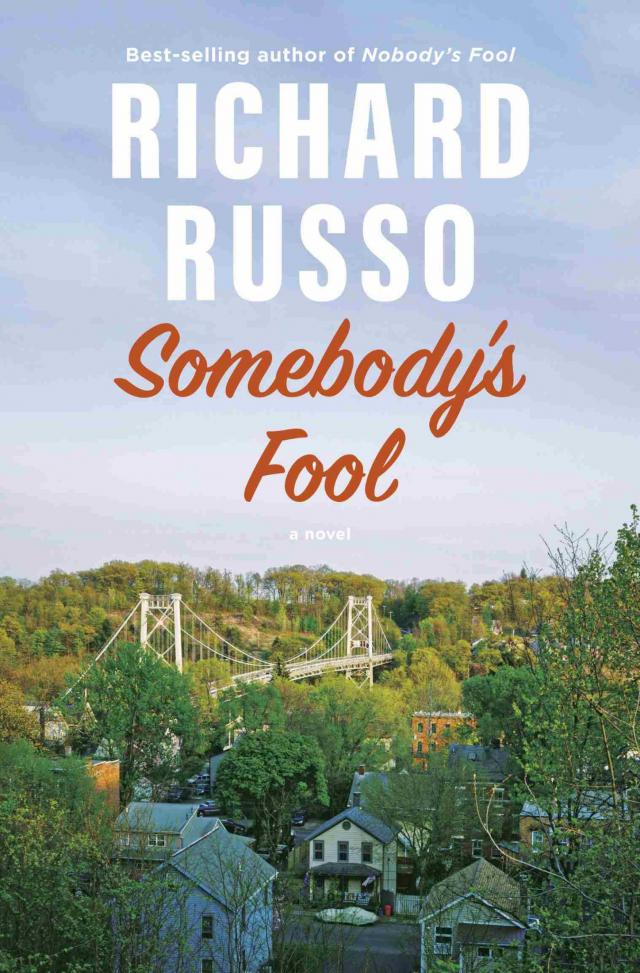
Cover photograph © glasslanguage / iStock / Getty Images
Cover design by Kelly Blair
ep_prh_6.1_144430952_c0_r0
Contents
Cover
Also by Richard Russo
Title Page
Copyright
Saturday
Inheritance
Owning It
Sully’s Ghost
A Pile of Teeth
[Hey, Little Bro—…]
Proctologist
Blackberry
Russians
Normal
Black Tooth
Lie Detector
Sunday
Roomies
[Me again, Little…]
Ruth’s List
Plumage
Benign
Dithering
Mission Creep
The Score
Businesses and Hobbies
What, Exactly?
Art
Too Late
Tag Team
[Little Bro—…]
Mojo
Atypical Behavior
More
Ad Infinitum
Gasoline
Hairball
Prophecy
Handset
Men in General
[Me, Again—…]
Superpower
Monday
Knowing
Cahoots
Magic Slate
Acknowledgments
A Note About the Author
_144430952_
SATURDAY
Inheritance
THE CHANGES WOULD BE gradual, or that was how the idea had been sold all along. But no sooner did North Bath’s annexation to Schuyler Springs become official than rumors began circulating about “next steps.” North Bath High, the Beryl Peoples Middle School, and one of the town’s two elementary schools would close at the end of the school year, just a few months away. In the fall their students would be bused to schools in Schuyler. Okay, none of this was unexpected. The whole point of consolidation was to eliminate redundancies, so education, the most expensive of these, would naturally be at the top of that list. Still, those pushing for annexation had argued that such changes would be incremental, the result of natural attrition. Teachers wouldn’t be fired, merely encouraged, by means of incentives, to retire. Younger staff would apply for positions in the Schuyler Unified school district, which would make every effort to accommodate them. The school buildings themselves would be converted into county offices. Same deal with the police. The low-slung brick building that housed the police department and the jail would be repurposed, and Doug Raymer, who’d been making noises about retiring as chief of police for years, could probably get repurposed as well. His half-dozen or so officers could apply for positions within the Schuyler PD. Hell, they’d probably even keep their old uniforms; the left sleeve would just bear a different patch. Sure, other redundancies would follow. There’d be no further need for a town council (there being no town) or for a mayor (which in Bath wasn’t even a full-time position). The town already purchased its water from Schuyler Springs, whose sanitation department would now collect its trash, which everybody agreed was a significant upgrade. At present Bath citizens were responsible for hauling their crap to the dump, or hiring the Squeers Brothers and letting their fleet of decrepit dump trucks do it for them.
Naturally, not everyone had been in favor of this quantum shift. Some maintained there was really only one genuine redundancy that annexation would eliminate, and that was North Bath itself. By allowing itself to be subsumed by Schuyler Springs, its age-old rival, the town was basically committing suicide, voting for nonexistence over existence, and who in their right mind did that? This melodramatic argument was met with considerable derision. Was it even possible for an intubated patient on a ventilator to commit suicide? For the last decade about the only thing Bath had any control over was its morphine drip, because its debt had become so crushing that the town budget allowed for little beyond its interest payment.
How had all this come to pass? Well, the recession the whole damn country was still in the middle of was partly to blame, but many argued that the town had been circling the drain long before that. Most people blamed Gus Moynihan and the damned Democrats, who, when they took power, just spent and spent and spent. Before that, Bath had been a model of fiscal restraint, its unofficial motto being: No spending. Ever. On anything. For any purpose. If there was a pothole in the middle of the street, drive around the fucking thing. It wasn’t like potholes were invisible. The wider and deeper they grew, the easier they were to spot. Hell, it wasn’t that long ago that the streets weren’t paved at all. No, the fiscal crisis was due to a curious combination of hubris and self-loathing, the anti-annexers maintained, the inevitable result of Bath’s attempts to emulate its rich neighbor. The Democrats, being Democrats, figured that if the town spent money like Schuyler Springs did, maybe it could have everything Schuyler had. You had to spend money to make money, right? Okay, sure, Republicans countered, but what the Democrats were conveniently ignoring was that Schuyler Springs, a lucky town if there ever was one, had money to burn. The city was flush. It was full of fancy restaurants and coffee shops and museums and art galleries. It had a thoroughbred racetrack, a performing arts center and writers’ colony and snooty liberal arts college, all of which generated a veritable shitstorm of revenue. How was Bath supposed to compete with all that? Moreover, why would they even want to? After all, there were other ways of measuring wealth, other sources of civic pride. Schuyler might be lucky—its mineral springs still percolating up out of the ground more than a century after Bath’s ran dry—but the historic drivers of its economy were gambling and horseracing and prostitution (a claim advanced by North Bath fundamentalist churches, though the only whorehouse of historical note had actually been located on their own outskirts), all of which explained why Schuyler was full of rich assholes and latte-drinking homosexuals and one-God-at-most Unitarian churches, a town where morally upright, God-fearing, hardworking people couldn’t afford to live. That it hadn’t gotten its comeuppance yet didn’t mean there wasn’t one coming. If potholes and second-rate schools kept taxes low and degenerates, atheists and Starbucks out, then let’s hear it for potholes.
That was the other thing: taxes. If Bath was subsumed by Schuyler, how much longer would they remain low? Those in favor of annexation conceded that, yes, eventually, if Schuyler Springs assumed North Bath’s debt, at some point all town property would have to be reassessed. Taxes might conceivably go up. Language like eventually and at some point and might conceivably had the intended effect of rendering these outcomes as remote and possible, as opposed to immediate and inevitable. Now, though, word on the street was that this reassessment of both residential and commercial properties would commence next week. Just that quickly eventually had become a synonym for tomorrow. So, yes, North Bath teachers and cops and other public servants could apply for their old jobs in Schuyler schools and the Schuyler PD, but if their property taxes doubled, how many of them could afford to keep living there? Sure, residents with the nicest houses in the better neighborhoods would make a killin
Birdie, who was the principal owner of Bath’s venerable roadhouse, the White Horse Tavern, had followed the civic debate with interest, despite not really having a dog in the fight. The way she saw it, she was pretty much screwed either way. If the tavern was reassessed and her taxes doubled, then she’d probably lose not just the business but her home, since she lived in the apartment upstairs. Theoretically the property would be worth more, but that would also make it even harder to sell. While the tavern wasn’t technically on the market, it was common knowledge that Birdie had been looking for an off-ramp for a while now. She’d recently turned sixty-three, and most mornings, including this one, she woke up feeling like she’d been rode hard and put up wet. She couldn’t afford to retire, but how many more years of hard labor did she have in her? A decade ago the bar had kept her afloat during the winter, but not anymore. Summers were still busy, of course. She opened the main dining room around Memorial Day, hired seasonal waitstaff and cooks who pushed steaks and prime rib out of the crowded kitchen and into the expansive dining room, but all of that went away after Labor Day. She kept the kitchen open as a service, but mostly for burgers and pizza. The whole place needed a good sprucing up, and not just a fresh coat of paint, either. Every stick of furniture in the joint needed replacing, and she’d been putting off purchasing new point-of-sales equipment for years. She wanted to update her software, too, something her ancient computer wouldn’t support. Face it. The Horse was, like the town itself, on a respirator. Maybe it was time to pull the plug. Put a merciful end to her misery. Before the recession she’d been hoping for—praying for, really—somebody from away to wander into the tavern and be both charmed by its historic vibe and blind to its present decrepitude. Someone capable of closing their eyes and seeing in the resulting darkness a bright future. A romantic fool, in other words. Unfortunately, people like that were more likely to invest in bookstores and B and Bs than roadhouse taverns.
Still, you never knew, which was why Birdie was paying particular attention to another rumor that was currently making the rounds: the one about the Sans Souci—the old hotel that sat in the middle of a large, wooded estate situated between Bath and Schuyler Springs. Of course the place had always been a rumor mill. Every few years there’d be talk that some downstate investor was interested, that the old hotel would be renovated yet again, a celebrity chef brought up from Manhattan to run its high-end restaurant, the extensive grounds converted into a golf course or maybe a music venue to rival Schuyler’s performing arts center. Others believed that the state of New York would eventually step in, purchase the land and make a public park out of it. This new scuttlebutt was strikingly different: somebody already had bought the Sans Souci, and not some downstater, but a West Coast billionaire and movie studio owner who meant to tear the hotel down and build a soundstage in its place. That was last week’s scenario. This week’s purchaser was a Silicon Valley tech firm looking for an East Coast presence by replacing the Sans Souci with an entire campus built from the ground up, which would mean hundreds, if not thousands, of employees. Overnight the whole area would be flooded with new people, all of them looking not just for housing but for places to eat and drink. Could it be that for once in her life Birdie was actually in the right place at the right time? She never had been before, but where was it written that her luck couldn’t change? Her old friend Sully had been as unlucky as anybody she knew until one day his luck turned with a vengeance. Why not her?
* * *
—
Birdie was contemplating this rosy possibility when she heard Peter Sullivan, Sully’s son and one of her two minority business partners, letting himself in via the tavern’s delivery entrance, as he did every Saturday morning without fail. Peter seemed to believe he was a very different breed of cat than his father, which always made Birdie smile, though in some respects she supposed it might be true. College educated, he was white collar where Sully had been faded blue, and Peter was both well dressed and articulate. In other respects, however, he was his old man all over again. If you ever needed to know where Sully was, all you had to do was glance at your watch. At seven he’d be at Hattie’s for his morning coffee. Eight-thirty would find him at Tip Top Construction, where Carl Roebuck, its owner, would let him know what disgusting job he’d lined up for him that day, one even Sully couldn’t fuck up. Over the noon hour he’d drop by the OTB, where he’d bet his 1-2-3 exacta and shoot the shit with the other regulars there. Six o’clock or thereabouts would find him back home, in the shower, scrubbing off the day’s grime (though he’d sometimes skip going home if the job ran long). By seven he’d be on his favorite barstool here at the Horse, where there was always cold beer and The People’s Court or a ball game on the wall-mounted TV, not to mention the regular bar crowd—Wirf, Jocko, Carl and the others, all gone now, dead or moved away or drinking elsewhere—whose balls he enjoyed breaking. And there he’d stay, until midnight on weekdays, or last call on weekends, after which, if a poker game broke out in the back room, so much the better. He’d kept to that schedule pretty much right up to the end, even when the knee he’d injured years before got so stiff and painful that the few people who didn’t know him assumed he had a prosthesis.
Peter seemed to believe that because he drank coffee at the Horse on Saturday mornings instead of beer there every night of the week and because he read the New York Times instead of watching The People’s Court, he’d won some sort of victory over genetics. Birdie had her doubts. With each passing day he looked more like his old man, and while she wasn’t privy to the details of his day, she knew its broad strokes—teaching at the community college during the week, on Saturdays slow-walking the ongoing renovations to the house on Upper Main Street that his father had left him, playing racquetball (whatever that was) or tennis at a fitness club in Schuyler on Sundays. Evenings? Every now and then he’d stop by the Horse for a martini (Birdie stocked his favorite high-end vodka), but he usually drank at that hipster bar in Schuyler, the kind of place where a glass of wine went for twelve bucks and you weren’t supposed to mind the short pour. Peter’s routines, in other words, were every bit as ingrained and regimented as Sully’s had been, which was why Birdie foresaw that the DNA contest Peter imagined he was winning would end in ignominious defeat.
And how different he already was from the young fellow who’d arrived in North Bath back in the late eighties, his marriage in tatters, his family splintering. Shaken by having just lost his university teaching position but still encased in a protective layer of irony, he managed to convey to everyone that his life was a game he was playing under protest, one he expected to be upheld when his case was finally heard. Sure, he was stuck in Bath for the time being, but he’d made it clear that he wouldn’t be staying a moment longer than necessary. A few years at most. Once Will graduated from high school, it was adios amigos. But then he began inheriting things. First, his mother’s house, a modest, three-bedroom ranch in a once solidly middle-class neighborhood that was now in decline. Vera had been an iron-willed, congenitally unhappy woman who worshipped her father, a Yale Ph.D. who’d chaired the Classics Department at Edison College over in Schuyler. As far as Vera was concerned, the man could do no wrong, and consequently none of the subsequent men in her life ever measured up. Sully certainly hadn’t, though what possessed her to imagine he would was a mystery. Enter Peter’s stepdad, Ralph, a kind, good-hearted doofus and Sully’s polar opposite. The poor man’s heroic efforts to make his wife happy, or at least less unhappy, elicited quiet contempt on a good day and wild-eyed rage on a bad one. And face it, Peter had ended up disappointing her, too. Yes, he’d become a scholar like his grandfather, but Vera could see his heart wasn’t in it, and when he failed to get tenure at an undistinguished state university, she let it be known that he’d disappointed both her and his grandfather. Her only other demand had been that he forever bear a grudge against his own father for walking out on them, but it turned out he couldn’t even manage that. Instead of moving back into his childhood home and finding respectable work when his marriage broke up, Peter had instead gone to work with (no, for!) Sully, and after a year or two in a rented apartment with his son Will, he’d actually moved into the house Sully had by then inherited from old Beryl Peoples. He hadn’t meant that to be a slap in the face, Peter assured her, but really how else was she supposed to interpret it? Still, he was an only child. In the end, who else was she going to leave her house to?