

Cannibal capitalism, p.1
Cannibal Capitalism, page 1


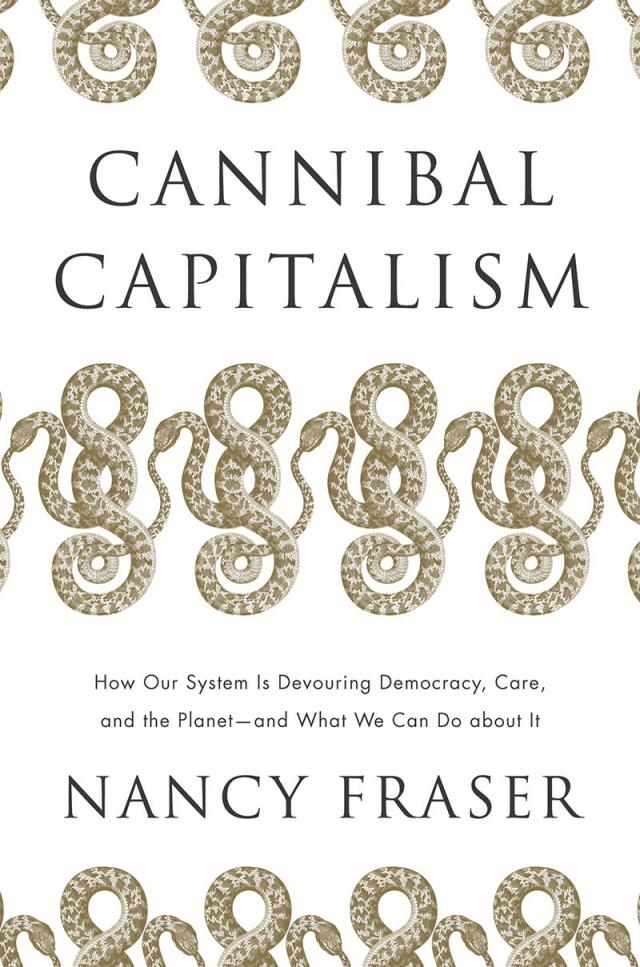
Cannibal Capitalism
Cannibal Capitalism
How Our System Is Devouring
Democracy, Care, and the Planet—
and What We Can Do about It
Nancy Fraser
First published by Verso 2022
© Nancy Fraser 2022
All rights reserved
The moral rights of the author have been asserted
1 3 5 7 9 10 8 6 4 2
Verso
UK: 6 Meard Street, London W1F 0EG
US: 388 Atlantic Avenue, Brooklyn, NY 11217
versobooks.com
Verso is the imprint of New Left Books
ISBN-13: 978-1-83976-123-2
ISBN-13: 978-1-83976-125-6 (US EBK)
ISBN-13: 978-1-83976-124-9 (UK EBK)
British Library Cataloguing in Publication Data
A catalogue record for this book is available from the British Library
Library of Congress Cataloging-in-Publication Data
A catalog record for this book is available from the Library of Congress
Typeset in Sabon by MJ & N Gavan, Truro, Cornwall
Printed in the US by Maple Press
for Robin Blackburn and Rahel Jaeggi,
indispensable dialogue partners and dear friends
Contents
Acknowledgments
Preface: Cannibal Capitalism: Are We Toast?
1. Omnivore: Why We Need to Expand Our Conception of Capitalism
2. Glutton for Punishment: Why Capitalism Is Structurally Racist
3. Care Guzzler: Why Social Reproduction Is a Major Site of Capitalist Crisis
4. Nature in the Maw: Why Ecopolitics Must Be Trans-environmental and Anti-capitalist
5. Butchering Democracy: Why Political Crisis Is Capital’s Red Meat
6. Food for Thought: What Should Socialism Mean in the Twenty-First Century?
Epilogue: Macrophage: Why COVID Is a Cannibal Capitalist Orgy
Notes
Index
Acknowledgments
It is common to think of a book as the fruit of its author’s individual labor. But that view is deeply misleading. Virtually every writer relies on a host of enabling background conditions —financial support and library access, editorial guidance and research assistance, collegial criticism and inspiration, encouragement from friends, and care from intimates and family members. These constitute the “hidden abodes” of authorship, to invoke a phrase that plays a key role in the pages that follow. Too often relegated to the backstage, while the author preens in front, they are indispensable conditions for a book’s publication. Without them it could not see the light of day.
Clearly, a book that theorizes the hidden supports of capitalist production must acknowledge its own underpinnings. These came in many forms and from many sources. On the institutional front, the New School for Social Research provided a flexible teaching arrangement, a year of sabbatical leave, and (most important of all) an environment of intellectual vibrancy. Dartmouth College hosted me as Roth Family Distinguished Visiting Scholar in 2017–18 and later gave me a second academic home with a superb library, generous funding, and accomplished colleagues.
Several other institutions gave me precious time and collegial surroundings in which to develop the ideas in this book. Warmest thanks to Jude Browne and the University of Cambridge Centre for Gender Studies; to Michel Wieviorka and the Collège d’études mondiales; to Rainer Forst and the Justitia Amplificata Centre for Advanced Studies, Frankfurt, and the Forschungskolleg Humanwissenschaften, Bad Homburg; to Hartmut Rosa and the Research Group on Post-Growth Societies, Friedrich-Schiller-Universität, Jena; and to Winfried Fluck, Ulla Haselstein, the Einstein Foundation of Berlin, and the JFK Institute for American Studies, Frei Universität, Berlin.
I relied throughout on the research skills and camaraderie of an extraordinary group of graduate assistants. My heartfelt gratitude goes to Blair Taylor, Brian Milstein, Mine Yildirim, Mayra Cotta, Daniel Boscov-Ellen, Tatiana Llaguno Nieves, Anastasiia Kalk, and Rosa Martins.
Several journals, but especially New Left Review and Critical Historical Studies, gave me the precious opportunity to circulate early accounts of the ideas expounded here and to receive feedback that helped me refine them. The specifics of my debts to them and to others who published previous formulations of these ideas are acknowledged below.
Verso provided the editor I’ve always dreamed of in Jessie Kindig, whose enthusiasm, creativity, and way with words made all the difference. Also at Verso, production editor Daniel O’Connor and copyeditor Stan Smith transformed a messy and much revised manuscript into a finished, error-free set of pages. Under the direction of Melissa Weiss, David Gee designed a standout cover, at once elegant and (dare I say) biting.
Behind this book, too, stands the indispensable support of colleagues and friends. I have thanked some of them in the notes to individual chapters, where their influence loomed especially large. But some have shaped and inspired my thoughts more broadly and over the longer haul. Among these steadfast companions and dialogue partners, I thank Cinzia Arruzza, Banu Bargu, Seyla Benhabib, Richard J. Bernstein, Luc Boltanski, Craig Calhoun, Michael Dawson, Duncan Foley, Rainer Forst, Jürgen Habermas, David Harvey, Axel Honneth, Johanna Oksala, Andreas Malm, Jane Mansbridge, Chantal Mouffe, Donald Pease, the late Moishe Postone, Hartmut Rosa, Antonia Soulez, Wolfgang Streeck, Cornel West, and Michel Wieviorka.
Two more, to whom this book is dedicated, were in my thoughts and heart throughout the writing. I thank Robin Blackburn, on whose erudition, insight, and kindness I relied again and again; and Rahel Jaeggi, my true partner in “conversation,” with whom many of the ideas presented here were originally developed and later improved.
Lastly, there is Eli Zaretsky, whose support for this book was so profound, multi-faceted, and pervasive as to defy any summary statement. Let’s just say that Cannibal Capitalism wouldn’t exist without his probing intelligence, largeness of vision, and sustaining love.
Earlier versions of several of these chapters have been previously published and appear here in revised form, with permission from their original publishers.
An earlier version of chapter 1 was delivered as the 2014 Diane Middlebrook and Carl Djerassi Lecture at the University of Cambridge on February 7, 2014, and later published in New Left Review, issue 86 (2014), as “Behind Marx’s Hidden Abode: For an Expanded Conception of Capitalism.” Its arguments went through a baptism of fire, and came out the stronger for it, through challenging discussions with Rahel Jaeggi, many of which are recorded in our coauthored book Capitalism: A Conversation in Critical Theory, edited by Brian Milstein (to be republished by Verso in April 2023). Thanks again to Jaeggi for her probing intelligence and warmhearted friendship.
An earlier version of chapter 2 was first delivered as the presidential address at the one hundred fourteenth Eastern Division meeting of the American Philosophical Association in Savannah, Georgia, on January 5, 2018, and later published in Proceedings and Addresses of the American Philosophical Association, volume 92 (2018), as “Is Capitalism Necessarily Racist?” I am grateful to Robin Blackburn, Sharad Chari, Rahel Jaeggi, and Eli Zaretsky for helpful comments on this chapter, to Daniel Boscov-Ellen for research assistance, and especially to Michael Dawson for inspiration and stimulation.
An earlier version of chapter 3 was first delivered as the thirty-eighth annual Marc Bloch Lecture at the École des hautes études en sciences sociales in Paris on June 14, 2016, and later published in New Left Review, issue 100 (2016), as “Contradictions of Capitalism and Care.” Many of its arguments were developed in conversation with Cinzia Arruzza and Johanna Oksala, to whom I am deeply grateful.
Earlier versions of chapter 4 were delivered in Vienna as the inaugural lecture of the first Karl Polanyi Visiting Professorship on May 4, 2021, as “Incinerating Nature: Why Global Warming is Baked into Capitalist Society,” and published in New Left Review, issue 127 (2021), as “Climates of Capital: For a Trans-environmental Eco-socialism.”
Earlier versions of chapter 5 were published, first, in Critical Historical Studies, volume 2 (2015), as “Legitimation Crisis? On the Political Contradictions of Financialized Capitalism,” and later in German translation in Was stimmt nicht mit der Demokratie? Eine Debatte mit Klaus Dörre, Nancy Fraser, Stephan Lessenich und Hartmut Rosa, edited by Hanna Ketterer and Karina Becker (Suhrkamp Verlag, 2019).
An earlier version of chapter 6 was first delivered as the 2019 Solomon Katz Distinguished Lecture in the Humanities at the University of Washington, May 8, 2019, and later published in Socialist Register, volume 56, Beyond Market Dystopia: New Ways of Living (2019), as “What Should Socialism Mean in the 21st Century?”
Preface
Cannibal Capitalism: Are We Toast?
Readers of this book don’t need me to tell them that we’re in trouble. They’re already tuned in to, indeed reeling from, a tangle of looming threats and realized miseries: crushing debt, precarious work, and besieged livelihoods; dwindling services, crumbling infrastructures, and hardened borders; racialized violence, deadly pandemics, and extreme weather—all overarched by political dysfunctions that block our ability to envision and implement solutions. None of this is breaking news, and none needs belaboring here.
What this book does offer is a deep dive into the source of all these horribles. It diagnoses what drives the malady and names the perp. “Cannibal capitalism” is my term for the social system that has brought us to this point. To see why the term i
“Cannibalism” has several meanings. The most familiar, and the most concrete, is the ritual eating of human flesh by a human being. Burdened by a long racist history, the term was applied by an inverted logic to Black Africans on the receiving end of Euro-imperial predation. So there’s a certain satisfaction in turning the tables and invoking it here as a descriptor for the capitalist class—a group, this book will show, that feeds off everyone else. But the term also has a more abstract meaning, which captures a deeper truth about our society. The verb “to cannibalize” means to deprive one facility or enterprise of an essential element of its functioning for the purpose of creating or sustaining another one. That, we’ll see, is a fair approximation of the relation of capitalism’s economy to the system’s non-economic precincts: to the families and communities, habitats and ecosystems, state capacities and public powers whose substance its economy consumes to engorge itself.
There is also a specialized astronomical meaning: a celestial object is said to cannibalize another such object when it incorporates mass from the latter through gravitational attraction. That, I will show here, too, is an apt characterization of the process by which capital draws into its orbit natural and social wealth from peripheral zones of the world system. There is, finally, the ouroboros, the self-cannibalizing serpent that eats its own tail, depicted on this book’s cover. That’s a fitting image, we’ll also see, for a system that’s wired to devour the social, political, and natural bases of its own existence —which are also the bases of ours. All told, the cannibal metaphor offers several promising avenues for an analysis of capitalist society. It invites us to see that society as an institutionalized feeding frenzy—in which the main course is us.
“Capitalism,” too, cries out for clarification. The word is commonly used to name an economic system based on private property and market exchange, wage labor and production for profit. But that definition is too narrow, obscuring rather than disclosing the system’s true nature. “Capitalism,” I’ll argue here, better designates something larger: a societal order that empowers a profit-driven economy to prey on the extra-economic supports it needs to function—wealth expropriated from nature and subject peoples; multiple forms of carework, chronically undervalued when not wholly disavowed; public goods and public powers, which capital both requires and tries to curtail; the energy and creativity of working people. Although they do not appear on corporate balance sheets, these forms of wealth are essential preconditions for the profits and gains that do. Vital underpinnings of accumulation, they, too, are constitutive components of the capitalist order.
In this book, accordingly, “capitalism” refers not to a type of economy but to a type of society: one that authorizes an officially designated economy to pile up monetized value for investors and owners, while devouring the non-economized wealth of everyone else. Serving that wealth on a platter to the corporate classes, this society invites them to make a meal of our creative capacities and of the earth that sustains us—with no obligation to replenish what they consume or repair what they damage. And that is a recipe for trouble. Like the ouroboros that eats its own tail, capitalist society is primed to devour its own substance. A veritable dynamo of self-destabilization, it periodically precipitates crises while routinely eating away at the bases of our existence.
Cannibal capitalism, then, is the system to which we owe the present crisis. Truth be told, it’s a rare type of crisis, in which multiple bouts of gluttony have converged. What we face, thanks to decades of financialization, is not “only” a crisis of rampaging inequality and low-waged precarious work; nor “merely” one of care or social reproduction; nor “just” a crisis of migration and racialized violence. Neither is it “simply” an ecological crisis in which a heating planet disgorges lethal plagues, nor “only” a political crisis featuring hollowed-out infrastructure, ramped-up militarism, and a proliferation of strongmen. Oh no, it’s something worse: a general crisis of the entire societal order in which all those calamities converge, exacerbating one another and threatening to swallow us whole.
This book maps that massive tangle of dysfunction and domination. Expanding our view of capitalism to include the extra-economic ingredients of capital’s diet, it brings together in a single frame all the oppressions, contradictions, and conflicts of the present conjuncture. In this frame, structural injustice means class exploitation, to be sure, but also gender domination and racial/imperial oppression—both non-accidental by-products of a societal order that subordinates social reproduction to commodity production and that demands racialized expropriation to underwrite profitable exploitation. As understood here, likewise, the system’s contradictions incline it not only to economic crises but also to crises of care, ecology, and politics, all of which are in full flower today, courtesy of the long spell of corporate bingeing known as neoliberalism.
As I conceive it, lastly, cannibal capitalism precipitates a broad array and complex mix of social struggles: not just class struggles at the point of production, but also boundary struggles at the system’s constitutive joints. Where production butts up against social reproduction, the system incites conflicts over care, both public and private, paid and unpaid. Where exploitation crosses expropriation, it foments struggles over “race,” migration, and empire. Then too, where accumulation hits natural bedrock, cannibal capitalism sparks conflicts over land and energy, flora and fauna, the fate of the earth. Finally, where global markets and megacorporations meet national states and institutions of transnational governance, it provokes struggles over the shape, control, and reach of public power. All these strands of our present predicament find their place in an expanded conception of capitalism that is simultaneously unitary and differentiated.
Armed with this conception, Cannibal Capitalism poses a pressing existential question: “Are we toast?” Can we figure out how to dismantle the social system that is driving us into the jaws of obliteration? Can we come together to address the entire crisis complex that system has spawned—not “just” the heating of the earth, nor “only” the progressive destruction of our collective capacities for public action, nor “merely” the wholesale assault on our ability to care for one another and sustain social ties, nor “simply” the disproportionate dumping of the ensuing fallout on poor, working-class, and racialized populations, but the general crisis in which these various harms are intertwined? Can we envision an emancipatory, counterhegemonic project of eco-societal transformation of sufficient breadth and vision to coordinate the struggles of multiple social movements, political parties, labor unions, and other collective actors—a project aimed at laying the cannibal to rest once and for all? In the current conjuncture, I argue here, nothing short of such a project can avail.
Once we expand our view of capitalism, moreover, we must also expand our vision of what should replace it. Whether we call it socialism or something else, the alternative we seek cannot aim to reorganize the system’s economy alone. It must also reorganize the latter’s relation to all those forms of wealth it currently cannibalizes. What must be reinvented, then, is the relation of production to reproduction, of private to public power, of human society to nonhuman nature. If this sounds like a tall order, it’s our best hope. Only by thinking big can we give ourselves a fighting chance to vanquish cannibal capitalism’s relentless drive to eat us whole.
1
Omnivore: Why We Need to Expand
Our Conception of Capitalism
Capitalism is back! After decades in which the term could scarcely be found outside the writings of Marxist thinkers, commentators of varying stripes now worry openly about its sustainability, scholars from every school scramble to systematize criticisms of it, and activists throughout the world mobilize in opposition to its practices. Certainly, the return of “capitalism” is a welcome development, a crystal-clear marker, if any were needed, of the depth of the present crisis—and of the pervasive hunger for a systematic account of it. What all the talk about capitalism indicates, symptomatically, is a growing awareness that the heterogeneous ills—financial, economic, ecological, political, social—that surround us can be traced to a common root; and that reforms that fail to engage with the deep structural underpinnings of these ills are doomed to fail. Equally, the term’s renaissance signals the wish in many quarters for an analysis that clarifies the relations among the disparate social struggles of our time—an analysis that could foster the close cooperation, if not the full unification, of their most advanced, progressive currents within a counter-systemic bloc. The hunch that such an analysis should center on capitalism is on the mark.






